
The mining industry relies on efficient mineral processing to extract valuable metals and minerals from raw ores while minimizing waste and environmental impact. As global demand for critical metals surges, understanding modern ore beneficiation techniques has become essential for mining engineers, metallurgists, and industry professionals. This guide provides a comprehensive breakdown of rock mineral processing flowsheets, from pre-concentration to final concentrate production. We will analyze the fundamental principles, key equipment, and emerging innovations shaping mineral separation—whether you're dealing with gold, copper, iron, or rare earth elements, mastering these processes enhances recoveries, reduces costs, and ensures sustainable resource utilization.
Overview of Mineral Processing
Mineral processing refers to the process of separating valuable minerals from gangue minerals through physical or chemical methods. It primarily comprises three fundamental stages:
- Pre-concentration Preparation: Crushing, screening, grinding, and classification.
- Separation Operations: Gravity separation, magnetic separation, flotation, electrical separation, etc.
- Post-separation Dewatering and Product Handling: Thickening, filtration, drying, and tailings treatment.
This comprehensive workflow progressively processes large-sized raw ore into qualified concentrates and waste tailings, thereby achieving the efficient separation of resources.
Detailed Explanation of the Core Process Flow
Effective mineral processing begins with ore preparation—liberating valuable minerals from gangue through size reduction. Without proper crushing and grinding, subsequent separation processes lose efficiency. Let’s examine how comminution systems optimize particle size for maximum recovery.
Pre-Beneficiation Preparation (Crushing + Grinding + Classification)
The core objective of pre-beneficiation preparation is to crush and fine-grind large ore lumps, thereby achieving the liberation of valuable mineral particles and creating the necessary conditions for subsequent beneficiation processes.
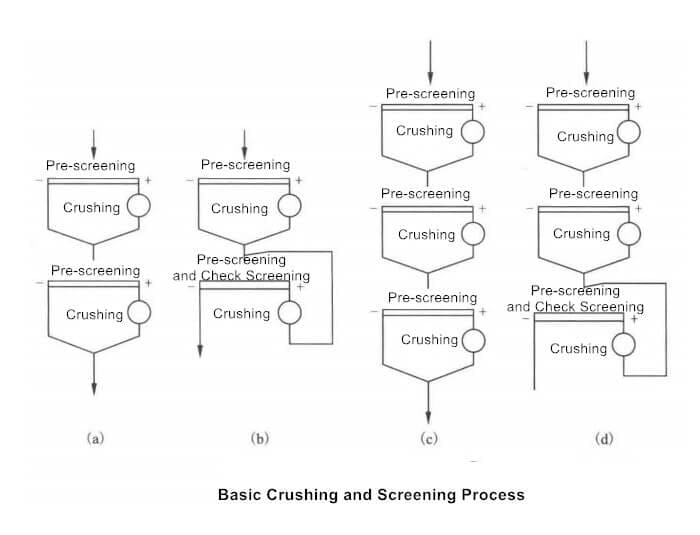
1. Crushing and Screening Operations
These operations reduce large lumps of mined raw ore (ranging from 200 to 2000 mm) down to a size of 10 to 25 mm, thereby preparing the material for the subsequent grinding stage.
- Common Process: Two-stage or three-stage crushing combined with closed-circuit screening.
- Core Function: To maximize crushing while minimizing grinding—a strategy designed to reduce grinding costs.
- Supporting Equipment: Jaw crushers, cone crushers, and vibrating screens.
2. Grinding and Classification Operations
These processes further reduce the size of the crushed products, ensuring the complete separation of valuable minerals from gangue (monomer dissociation).
- Fineness Requirements: Typically, the material is ground to a fineness where 60% to 80% passes through a 0.074 mm (200-mesh) screen.
- Core Equipment: Ball mills, rod mills, spiral classifiers, and hydrocyclones.
- Process Characteristics: The grinding mills and classifiers form a closed-circuit system, which prevents over-grinding and ensures uniform particle size.
Once minerals are sufficiently liberated, separation techniques are applied based on their physical or chemical properties. The choice between gravity, flotation, or magnetic separation depends on ore type, mineralogy, and economics. Below, we dissect each method’s role in modern processing plants.

Separation Operations (Gravity, Flotation, Magnetic, and Electrical Separation)
After the ore has been finely ground, separation is achieved by exploiting differences in mineral density, magnetism, floatability, and electrical conductivity.
1. Gravity Separation
Separation based on differences in mineral density is characterized by low environmental impact and low cost.
- Applications: Tungsten, Tin, Gold, Titanium, Rare Earth Elements
- Equipment: Jigging machines, Shaking tables, Spiral chutes, Centrifugal concentrators
2. Flotation Separation
Separation based on differences in mineral surface wettability is the most widely applied method.
- Applications: Copper ores, Lead-Zinc ores, Gold ores, Molybdenum ores, Fluorite
- Equipment: Flotation machines, Flotation columns
3. Magnetic Separation
Separation based on differences in magnetic properties.
- Applications: Magnetite, Ilmenite, Manganese ores, Weakly magnetic minerals
- Equipment: Permanent magnet drum separators, High-gradient magnetic separators
4. Electrical Separation and Other Methods
Separation based on properties such as electrical conductivity, friction coefficient, and color is used for the purification of rare metals and non-metallic minerals.
Even after successful mineral separation, concentrate handling is critical. High-moisture slurries cannot be shipped or smelted directly, necessitating dewatering stages that balance cost, efficiency, and environmental compliance.
Post-Beneficiation Dewatering (Thickening + Filtration + Drying)
Mineral processing products typically possess a high moisture content; therefore, dewatering is mandatory before transportation or smelting.
- Thickening: Rake thickeners and hydrocyclones are employed to remove the majority of free water.
- Filtration: Vacuum filters and filter presses are utilized to achieve further dewatering.
- Drying: Rotary dryers are used for concentrates requiring an extremely low moisture content.

Key Factors in Process Selection
- Ore Characteristics: Grain size distribution, mineral associations
- Economic Indicators: The balance point between recovery rate and grade
- Environmental Requirements: Wastewater treatment, comprehensive utilization of tailings
- Latest Trends: XRT smart sorting, bioleaching technology
Core Principles of Mineral Processing Flowsheets
- Maximize Crushing, Minimize Grinding: Prioritize crushing to reduce the extent of grinding and lower energy consumption.
- Early Recovery: Prioritize the recovery of coarse-grained and easily beneficiable minerals.
- Ensure Sufficient Liberation: The fineness of grinding determines the effectiveness of mineral separation.
- Simple and Reliable Flowsheet: Minimize processing steps to reduce costs and ensure stable production.
- Water Conservation, Environmental Protection, and Closed-Circuit Recycling: Maximize water recovery and utilization while minimizing effluent discharge.
Comprehensive and Universal Mineral Processing Flowsheet for Metal Ores
- Run-of-Mine Ore → Coarse Crushing (Jaw Crusher) → Intermediate Crushing (Cone Crusher) → Screening
- Screened Undersize → Grinding → Classification (Closed-Circuit)
- Classifier Overflow → Separation (Gravity / Flotation / Magnetic)
- Concentrate → Thickening → Filtration → Final Concentrate
- Tailings → Tailings Pond / Dry Stacking / Resource Utilization
Theoretical knowledge becomes actionable when applied to real-world ores. These case studies of copper, iron, and gold processing illustrate how flowsheets adapt to specific mineralogical challenges.
Typical Process Flow Examples
Porphyry Copper Ore: Semi-Autogenous Grinding + Ball Milling → Bulk Flotation → Copper-Molybdenum Separation
Anshan-Type Iron Ore: Stage Grinding → Stage Magnetic Separation → Reverse Flotation
Alluvial Gold Ore: Trommel Screening → Jigging Concentration → Shaking Table Purification
Frequently Asked Questions
Q: How is the optimal grinding fineness determined?
A: This requires conducting beneficiation tests on mineral samples; typically, the content of the -200 mesh fraction is used as the control parameter.
Q: How should abnormal flotation froth conditions be addressed?
A: Potential causes include abnormal pH levels, excessive reagent dosage, etc. It is recommended to begin by observing the froth.
Conclusion
Mineral processing is a dynamic interplay of science and engineering, where each step—from crushing to dewatering—must be optimized for economic viability and sustainability. Advances in AI-based sorting, bioleaching, and dry stacking are revolutionizing ore beneficiation, reducing water/energy use while boosting recoveries. Whether you're designing a new plant or troubleshooting an existing circuit, remembering the "maximize crushing, minimize grinding" principle ensures efficiency. For tailored solutions, always conduct ore characterization tests and consult metallurgical experts to navigate the complexities of mineral separation.