
Introduction
In the vast and fertile lands of Guinea, gold mining projects are flourishing with remarkable momentum. The West African nation, blessed with abundant mineral resources, has become a focal point for modern gold extraction techniques. To ensure efficient, environmentally friendly gold mining, these projects employ a sophisticated suite of advanced mineral processing equipment, including trommel screens, vibrating chutes, flat sluices, and shaking tables. This integrated approach not only maximizes gold recovery but also minimizes environmental impact, setting a new standard for sustainable mining practices in the region.
The Comprehensive Gold Recovery System
The gold extraction process in Guinea's alluvial deposits follows a methodical approach, with each piece of equipment playing a crucial role in the recovery chain.
1. Trommel Screens: The First Line of Separation
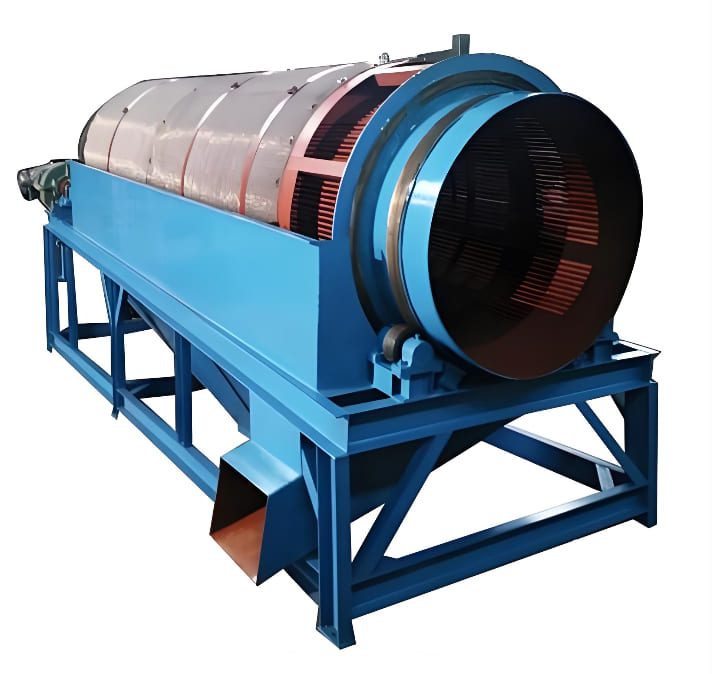
Trommel screens serve as the initial processing stage in Guinea's gold mining operations. These cylindrical, rotating devices effectively separate materials by size, enabling efficient downstream processing.
2. Vibrating Chutes: Enhanced Gravitational Separation
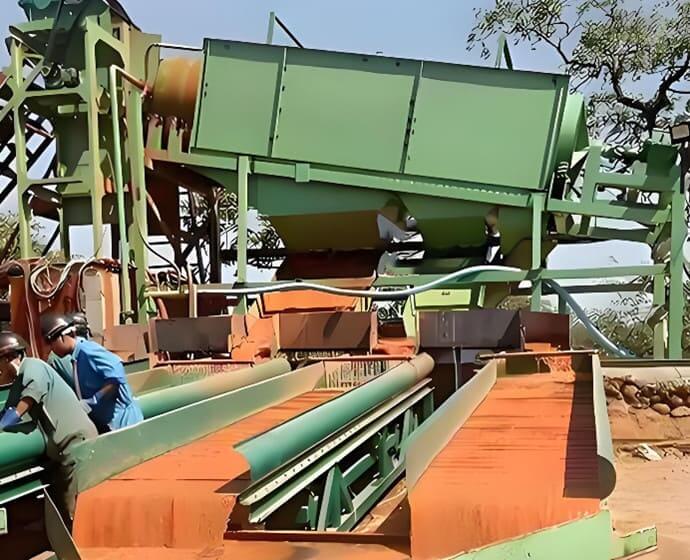
Following the initial screening, the material moves to vibrating chutes, which represent an evolution of traditional fixed sluices with added pulsation capabilities.
Working Principle
When slurry enters the sluice, light minerals and some fine heavy particles quickly flow across the sluice surface under water flow. Simultaneously, the rubber plate at the bottom of the sluice vibrates up and down due to the jigging mechanism, creating a pulsating effect. This vibration continuously loosens, stratifies, and settles heavy minerals between the sluice's baffles, forming a heavy mineral layer. Gold, with its higher specific gravity, gradually settles at the bottom of the sluice between the baffles, separating from lighter minerals.
Application Advantages
- Efficient separation of gold particles, significantly increasing recovery rates
- Strong adaptability to different particle sizes and types of alluvial gold ore
- Enhanced recovery of fine gold particles that might be lost in traditional sluices
3. Flat Sluices: Simple Yet Effective
The flat sluice represents a more traditional yet still highly effective component in the gold recovery system employed in Guinea's mining projects.
Working Principle
Flat sluices primarily separate materials based on their sliding speed and direction on a flat surface. Material enters from one end of the sluice and slides down under the influence of gravity and water flow. Due to differences in sliding speeds and directions, materials of varying particle sizes and types can be collected at different positions along the sluice.
Application Features
- Simple structure making maintenance straightforward in remote mining locations
- User-friendly operation allowing technicians to control separation effectiveness by adjusting feed rate and water flow
- Cost-effective solution delivering reliable results in Guinea's mining environment

4. Shaking Tables: Precision Final Recovery
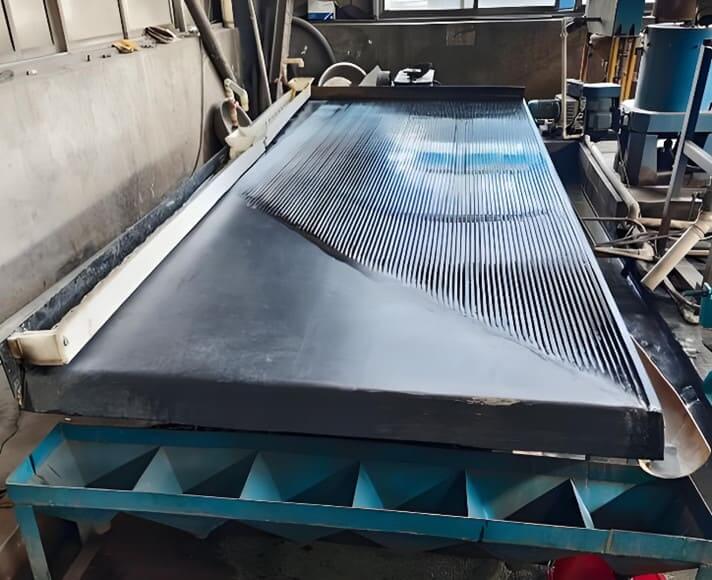
The shaking table represents the final and most precise stage in the gold recovery process, capturing fine gold particles that may have escaped earlier separation methods.
Working Principle
The motor drives the shaking table's crankshaft through a belt transmission, causing the connecting rod to move up and down. When the connecting rod moves downward, mineral material enters the inclined deck surface equipped with riffles through the ore chute. The table's water tank provides transverse impact water. Through this vibration and washing process, minerals of different specific gravity, particle size, and density flow out in different directions from the concentrate and tailings outlets on the table surface, directly forming concentrate.
Application Advantages
- High concentration ratio, typically far exceeding other mineral processing methods
- Superior precision in separating minerals of different particle sizes and densities
- Environmentally friendly operation without chemical reagents and with low power consumption
Integration for Maximum Efficiency
In Guinea's gold mining projects, these four types of equipment work collaboratively to form a complete mineral processing flow. The integration creates a systematic approach that maximizes gold recovery while minimizing environmental impact.
The process begins with the trommel screen performing preliminary screening to remove large impurities. The pre-screened material then passes through the vibrating chute for further separation of gold particles. Following this, the flat sluice handles the fine-grained separation. Finally, the shaking table provides precision separation for the smallest gold particles.
This integrated approach ensures that gold of various particle sizes is efficiently recovered at different stages of the process. The system's flexibility allows operators to adjust parameters based on the specific characteristics of the ore being processed, ensuring optimal recovery rates regardless of variations in the feed material.
Environmental and Economic Impact
Beyond technical efficiency, this integrated gold recovery system brings significant environmental and economic benefits to Guinea's mining sector. The primary mechanical separation processes minimize the need for chemicals like mercury and cyanide, which have traditionally been used in gold recovery with devastating environmental consequences.
From an economic perspective, the higher recovery rates translate directly into improved profitability for mining operations while extending the lifespan of gold deposits through more efficient extraction. Additionally, the relatively simple operation and maintenance requirements for much of this equipment create employment opportunities for local communities, contributing to sustainable development in Guinea's mining regions.
Conclusion
Guinea's gold mining projects demonstrate how traditional mining principles can be enhanced with modern engineering to create sustainable, efficient recovery systems. The combination of trommel screens, vibrating chutes, flat sluices, and shaking tables represents a comprehensive approach to gold recovery that balances technical efficiency with environmental responsibility.
As Guinea continues to develop its mineral resources, this integrated approach to gold extraction sets a positive example for other mining operations across Africa and beyond. By employing equipment that maximizes recovery while minimizing environmental impact, Guinea's gold mining sector is positioning itself for sustainable growth in the global mineral market.