
Placer gold deposits are secondary deposits formed when primary gold ores or gold-bearing geological bodies undergo weathering, erosion, and transport, followed by mechanical deposition and enrichment in rivers or specific landforms. Because placer deposits occur in a wide range of geological and geographical conditions, there is no single processing plant configuration that fits every project.
To meet the requirements of different types of ore deposits, the properties of the raw ore, and the needs of mining, transportation, and mechanized operations, gold processing plants for placer deposits can be categorized into three main types: stationary gold processing plants, semi-mobile gold processing plants (units), and mobile placer gold processing plants.
Although all three types are designed to recover gold from alluvial or placer deposits, they differ significantly in their mobility, equipment configurations, infrastructure requirements, and suitability for different mining conditions.
1. Stationary Placer Gold Processing Plants
Introduction
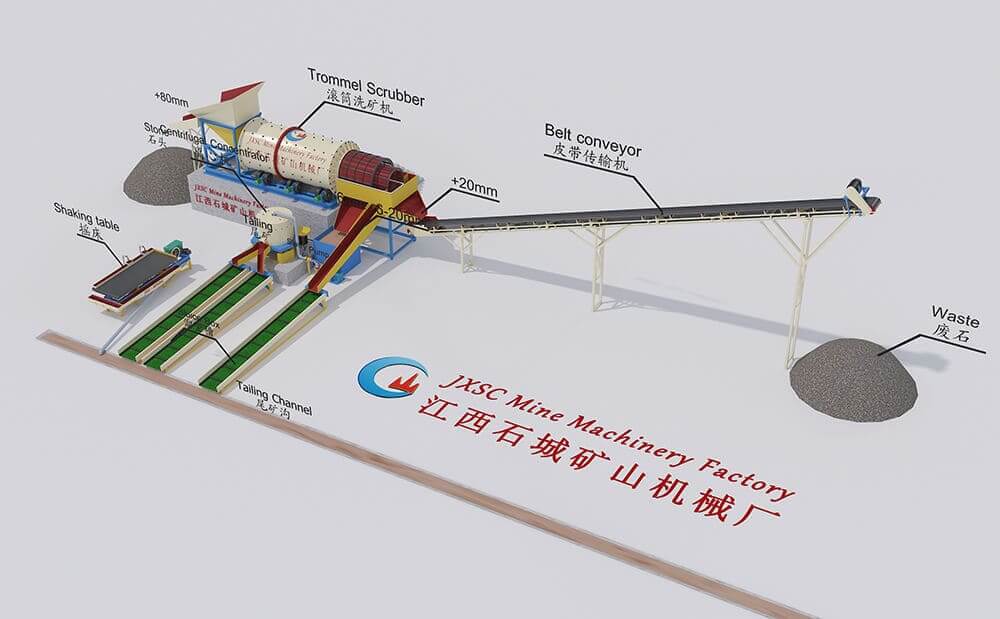
A stationary placer gold processing plant is a fixed processing facility constructed at a permanent location near the mining area. The plant normally includes a complete processing circuit consisting of ore feeding, washing, screening, gravity concentration, tailings handling, and, where necessary, additional concentration or recovery equipment.
Because the plant is designed for long-term operation at one location, it can be equipped with larger-capacity and more sophisticated equipment than highly mobile systems.
A typical stationary placer gold processing plant may include:
Feeding → Scrubbing/Washing → Screening → Gravity Concentration → Gold Concentrate Collection → Tailings Discharge
Depending on the ore characteristics, equipment such as trommels, vibrating screens, centrifugal concentrators, jigs, shaking tables, sluice boxes, pumps, and conveyors may be incorporated into the circuit.
Main Features
The defining characteristic of a stationary plant is that the processing equipment remains at a fixed site during the life of the project.
Typical features include:
- Fixed foundations or a permanent plant structure
- Relatively large processing capacity
- Multiple processing stages
- Larger feed hoppers and stockpiles
- Extensive conveyor and slurry-pumping systems
- Higher degree of process automation
- Greater flexibility for integrating different recovery equipment
- Permanent water supply, power, and tailings-management facilities
- Designed for long-term continuous operation
Stationary plants can also be customized according to the specific characteristics of the placer deposit.
For example, coarse gold deposits may require strong gravity-recovery equipment and careful nugget handling, while deposits containing a large amount of clay may require intensive scrubbing and desliming before gravity concentration.
Application
Stationary plants are most suitable when the placer deposit has:
- A relatively large or long mineable reserve
- Stable and predictable ore characteristics
- A long expected mine life
- High or continuous production requirements
- Convenient access to the processing site
- Sufficient space for permanent infrastructure
- Relatively favorable transportation and construction conditions
They are particularly appropriate for large-scale placer mining operations where moving the entire processing plant frequently would be economically impractical.
Pros & Cons
Unlike dredges, which are limited by hull area and space, stationary gold processing plants can employ more advanced processing flows and utilize a combination of various equipment for multi-stage processing. As a result, they achieve higher gold recovery rates and can comprehensively recover various heavy sand minerals. Furthermore, workers operate inside plant buildings, ensuring good working conditions, stable production operations, and convenient management. Although stationary gold processing plants offer many advantages, the thin gold-bearing layers in placer gold deposits, rapid mining advancement, and rising raw ore transportation costs year after year present challenges. Additionally, issues such as centralized water supply, tailings disposal, and the difficulty of backfilling mined-out areas significantly increase complexity and raise gold processing costs.
2. Semi-Mobile Placer Gold Processing Plants (Units)

Introduction
Semi-mobile placer gold processing plants, also called modular or unit-type plants, are positioned between stationary and fully mobile plants.
Instead of constructing one large permanent processing facility, the processing circuit is divided into several relatively independent units or modules. These units can be transported and reassembled when the mining location changes.
A semi-mobile plant may consist of separate modules such as:
- Feeding unit
- Trommel or washing unit
- Screening unit
- Gravity concentration unit
- Pumping unit
- Concentrate-cleaning unit
The individual units can be connected to form a complete processing circuit.
This design provides a balance between processing capacity and mobility.
Main Features
The key feature of a semi-mobile plant is its modular structure.
Compared with a stationary plant, it requires less permanent infrastructure. However, unlike a fully mobile plant, individual components may still need to be transported and assembled using loaders, trucks, cranes, or other machinery.
Typical characteristics include:
- Modular equipment configuration
- Skid-mounted, trailer-mounted, or containerized components
- Moderate processing capacity
- Relatively quick installation and dismantling
- Reduced civil construction requirements
- Flexible equipment combinations
- Suitable for multiple mining blocks or pits
- Can be expanded by adding additional modules
The modular approach also makes it easier to modify the processing circuit when ore characteristics change.
For example, a project could initially install a washing and screening module and later add a centrifugal concentrator or additional gravity-recovery unit if testwork shows that fine gold recovery needs improvement.
Application
Semi-mobile plants are particularly suitable for:
- Deposits divided into several mining blocks
- Deposits with moderate reserves
- Operations where the mining face gradually moves
- Remote areas with limited permanent infrastructure
- Projects requiring moderate processing capacity
- Operations where the plant may need to be relocated periodically
- Exploration-stage or developing projects that require processing flexibility
They are especially useful when a completely stationary plant would be unnecessarily expensive, but a fully mobile plant would not provide sufficient capacity or processing flexibility.
Pros & Cons
Semi-mobile plants offer a balanced solution with key advantages including optimal mobility-capacity balance (greater mobility than stationary plants yet higher processing capacity than compact mobile units), modular relocatability where components can be disassembled and reassembled at new sites, reduced infrastructure needs due to self-contained modules, flexible configurations adaptable to deposit characteristics, and scalability for phased project development - though they present disadvantages such as requiring significant time/equipment for relocation despite being more mobile than stationary plants, demanding assembly/disassembly labor between moves, carrying higher costs than smaller mobile units due to expanded capacity, and needing more supporting infrastructure than fully mobile systems despite requiring less permanent construction than fixed installations.
3. Mobile Placer Gold Processing Plants

Introduction
A mobile placer gold processing plant is designed for maximum mobility. The major processing components are integrated onto a mobile platform, trailer, chassis, skid, or similar transportable structure.
Unlike stationary plants, mobile plants are designed to move relatively easily as mining progresses.
A typical mobile placer gold processing plant may combine several functions into one integrated unit, such as:
Feeding → Washing → Screening → Gravity Gold Recovery → Tailings Discharge
Depending on the design, a mobile plant may incorporate a trommel, vibrating screen, hopper, sluice box, centrifugal concentrator, water pump, and supporting systems.
The primary design philosophy is simple: Move the processing plant closer to the ore instead of transporting large quantities of raw ore to a distant fixed plant.
Main Features
Mobile plants are characterized by compactness, integrated equipment, and rapid deployment.
Typical features include:
- Compact equipment arrangement
- Integrated processing system
- Trailer-, skid-, or crawler-mounted design
- Minimal site preparation
- Rapid installation
- Relatively short relocation time
- Low infrastructure requirements
- Suitable for remote or difficult-to-access areas
- Small to moderate processing capacity
Some mobile plants can be transported using standard trucks or other commonly available mining equipment.
Their compact design makes them particularly attractive for small placer deposits or mining operations where the ore body changes rapidly.
Application
Mobile placer gold processing plants are commonly suitable for:
- Small or scattered placer deposits
- Short-term mining areas
- Deposits with rapidly changing mining faces
- Remote locations
- Areas with poor road infrastructure
- Seasonal mining operations
- Trial mining and exploration projects
- Operations where minimizing ore transportation is important
They are particularly useful when the mining area is continuously moving and building a permanent processing facility would not be economical.
Pros & Cons
The mobile placer gold processing plant offers several advantages, including excellent mobility that allows the plant to be easily relocated closer to the mining area, rapid deployment with minimal infrastructure requirements, reduced ore transportation costs, and flexibility for remote or rapidly changing deposits. However, it also has drawbacks, such as limited processing capacity due to compact design, fewer options for process optimization, frequent relocation needs, dependency on site conditions like water availability and terrain, and little room for future expansion due to its fixed mobile configuration. These trade-offs make it ideal for small-scale or remote operations but less suited for large-scale, permanent mining setups.
Conclusion
Stationary, semi-mobile, and mobile placer gold processing plants represent three different approaches to solving the same fundamental problem: how to efficiently recover gold from alluvial deposits under specific mining and site conditions.
A stationary plant is generally the preferred solution for large, long-life deposits where high capacity, process stability, and comprehensive infrastructure justify the investment.
A semi-mobile plant provides a practical middle ground. Its modular design offers a useful combination of processing capacity, flexibility, and mobility, making it suitable for deposits developed across multiple mining areas.
A mobile plant prioritizes flexibility and rapid deployment. It is particularly attractive for small, scattered, remote, or frequently changing placer deposits where minimizing infrastructure and ore-haulage requirements is critical.
Ultimately, there is no universally "best" placer gold processing plant. The optimal choice depends on the deposit characteristics, mining method, ore properties, production target, transportation conditions, mine life, water availability, infrastructure, and investment budget.