
Nickel is a non-ferrous metal mineral characterized by strong corrosion resistance, heat resistance, and excellent plasticity and toughness. It has extensive industrial applications across steel production, non-ferrous metallurgy, electroplating, chemical engineering, machinery manufacturing, and defense industries.
Currently, exploitable nickel resources primarily consist of magmatic sulfide nickel ores and weathered oxide nickel ores (also known as laterite nickel ores). The former offers higher-grade ore, easier development, and mature processing technologies. However, due to increasing demand and diminishing sulfide deposits, oxide nickel mining has become the current market focus.
Let's explore the beneficiation processes, methods, and common equipment for both types of nickel ores!
Nickel Ore Beneficiation Process Flow
The conventional beneficiation process flow for nickel ore typically comprises several stages: crushing and screening, grinding and classification, separation, and tailings treatment.
1. Crushing and Screening Stage
Conventional nickel processing generally employs a single-stage or two-stage closed-circuit crushing process. The ore is fed into a crusher via a feeder for crushing and pre-screening. The undersized product is conveyed to a powder storage bin via a conveyor, where it is ready for grinding. The oversize material is transported to a medium-crushing bin (or returned to the crusher for re-grinding). After crushing, the material enters the screening stage. Qualified material proceeds to the next stage, while unqualified material is returned for further crushing.
Common nickel ore crushing and screening equipment: jaw crusher, cone crusher, circular vibrating screen, linear vibrating screen, etc.
2. Grinding and Classification Stage
Qualified crushed products are conveyed via belt to the powder silo and fed into ball mills for grinding. Qualified products proceed to the selection stage, while unqualified products enter hydrocyclones for classification. Undersized material returns to the primary ball mill for regrinding, while overflow proceeds to the selection stage.
Common nickel ore grinding and classification equipment: Energy-saving grate ball mills, overflow ball mills, hydrocyclones, etc.
3. Separation Stage
Nickel concentrate is obtained through various methods. For example, flotation involves scavenging, roughing, and cleaning processes to produce the final nickel concentrate product.
4. Thickening and Dewatering Stage
After selective separation, the concentrate is piped to thickeners for concentration and dewatering. Overflow can be recycled as return water, while underflow enters filter presses for filtration. Belt conveyors convey filter cakes to concentrate storage bins. Tailings undergo dewatering via dry tailings disposal processes and are transported to tailings storage facilities for stockpiling.
Common nickel concentrate/tailings dewatering equipment: High-efficiency thickener, high-frequency dewatering screen, chamber filter press, thickening hydrocyclone, etc.
Nickel Ore Beneficiation Processes
1. Beneficiation Processes for Nickel Sulfides
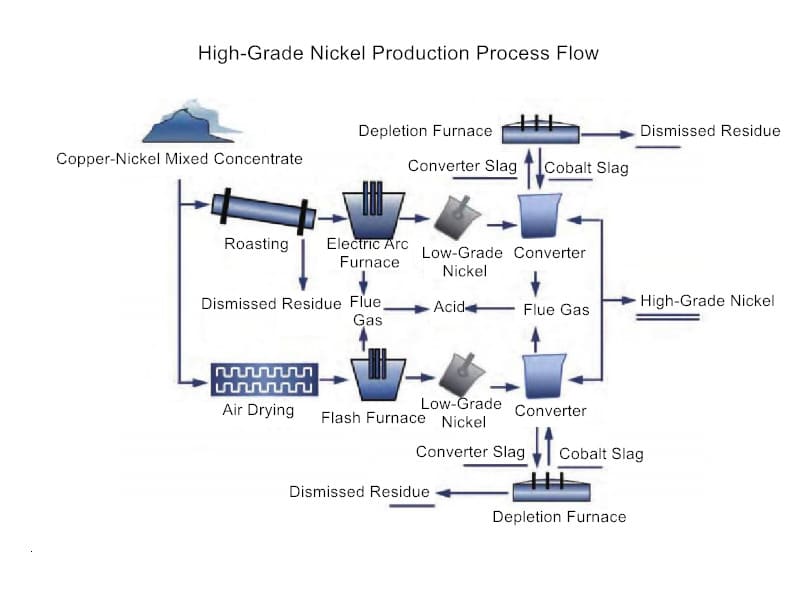
Most nickel sulfides in China are copper-nickel sulfide ores. The sulfide mineral aggregates in these ores exhibit uneven grain sizes, making them prone to over-grinding and oxidation. They also contain significant amounts of easily muddied, highly floatable magnesium-bearing gangue minerals. Processing methods for such ores include gravity separation, flotation, leaching, and combined separation techniques.
(1)Copper-Nickel Ore Gravity Separation
Gravity separation of copper-nickel ores refers to heavy medium separation (also known as heavy suspension separation), primarily suited for iron-nickel-platinum type copper-nickel ore processing. This method first separates dense and disseminated ore into heavy and light products, respectively, followed by individual flotation of each product. This gravity separation technique is generally employed as an auxiliary separation process.
Primary copper-nickel gravity separation equipment: Heavy-medium cyclone.
(2)Copper-Nickel Ore Flotation
Multiple flotation methods exist for copper-nickel ores, including priority flotation, mixed flotation, flash flotation, electrochemically controlled flotation, branch flotation, and asynchronous flotation. Priority flotation and mixed flotation are most commonly applied.
Preferential Flotation: Refers to the method of sequentially separating concentrates of two or more minerals based on priority order. It is typically applied to ores with relatively high copper content (higher than nickel) where copper is the primary recovery target.
Mixed Flotation: This method involves simultaneously separating two or more minerals to obtain a mixed concentrate, followed by the individual separation of each mineral. It is particularly suitable for copper-nickel ores with low grades, complex mineral intergrowths, and a high proportion of magnesium silicate gangue minerals that are prone to mudding and easy flotation.
Flash flotation: This involves pre-flotation of partially liberated or appropriately sized useful minerals before conventional flotation. It is primarily suitable for certain copper-nickel sulfide ores where conventional flotation yields unsatisfactory results due to uneven grain size distribution.
Electrochemically Controlled Flotation: A method that modifies the electrochemical conditions of the flotation system using chemical reagents to control the surface properties of target minerals. This process moderately oxidizes the surfaces of target minerals to enhance hydrophobicity while increasing the hydrophilicity of non-target minerals, thereby achieving separation. It is suitable for treating fine-grained sulfide ores where surface oxidation occurs due to specific elements.
Equal Floatation (also known as Separate Mixed Floatation): Refers to a process where useful minerals are classified as difficult-to-float or easy-to-float based on their floatability, followed by separation of easy-to-float minerals before difficult-to-float ones. Suitable for certain copper-nickel sulfide ores with fine grain size and complex ore properties.
Asynchronous flotation: (An advanced version of equal floatability) This method involves creating ideal flotation conditions for different minerals in separate stages based on ore property differences, followed by individual separation.
Branched flotation: During roughing, the original ore is divided into two or more streams. The froth from the first roughing stream is combined with the pulp from the next stream for further roughing. The final stream then undergoes scavenging.
Common nickel ore flotation equipment: Aerated agitation flotation machines, mechanically agitated flotation machines, coarse-particle flotation machines, etc.
(3)Copper-Nickel Ore Leaching Methods
Common leaching methods for sulfide copper-nickel ores include: pressurized ammonia leaching-hydrogen reduction-nickel powder, sulfurization roasting-leaching, pressurized acid leaching-replacement-flotation, and pre-oxidation roasting-selective reduction-ammonia leaching. These methods are primarily suited for sulfide copper-nickel ores with complex mineral compositions and fine grain sizes.
(4)Combined Copper-Nickel Separation Methods
This approach combines the aforementioned techniques based on mineral properties to maximize recovery of sulfide copper-nickel ores. When ores contain multiple associated useful minerals that cannot be separated using a single method to produce the final concentrate, combined separation methods are employed.
2. Nickel Laterite Ore Beneficiation Methods
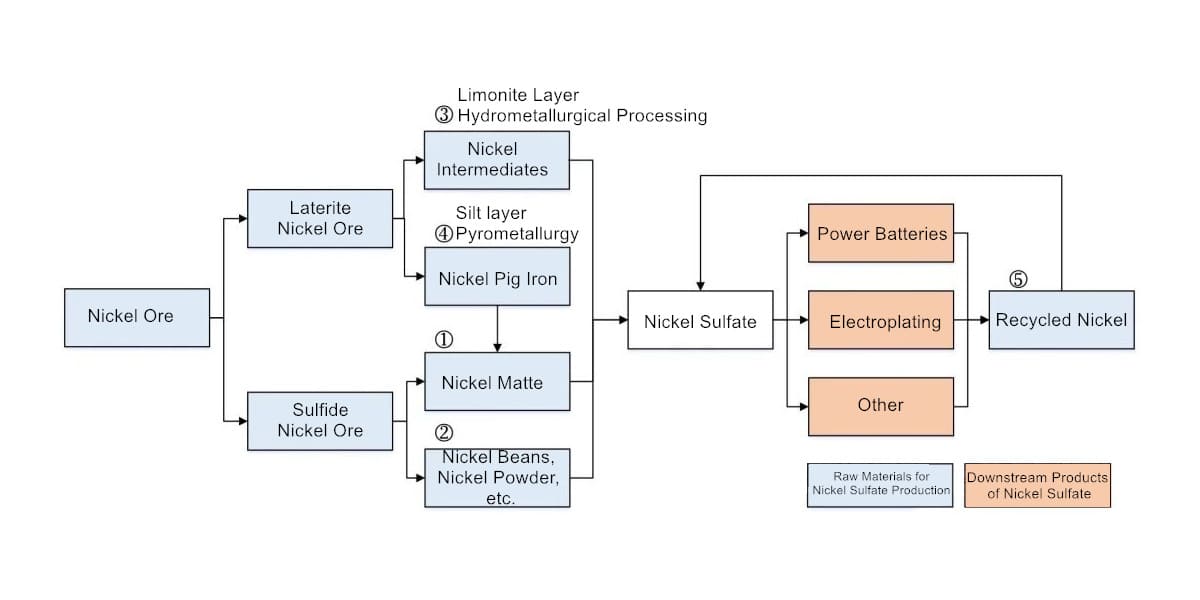
The primary beneficiation methods for nickel laterite ore (nickel oxide) are pyrometallurgical and hydrometallurgical processes.
(1)Pyrometallurgical Processes
Pyrometallurgical smelting processes are primarily divided into two types: reduction smelting of nickel-iron and reduction smelting for matte production.
The ore undergoes calcination or roasting. Basic requirements for the ore include crushing and screening, with coarse particles used for calcination. The particle size requirement is approximately 25mm to 150mm. Fine particles are discarded or agglomerated before calcination. To minimize energy consumption, pyrometallurgical processes require ore with the lowest possible moisture content. Therefore, ore preparation must avoid water washing; when necessary, ore should be dried before crushing and screening. This method is primarily used for processing high-grade laterite nickel ores, especially dry-type laterites.
(2)Hydrometallurgical Process
The hydrometallurgical process primarily includes bacterial leaching, ammonia leaching after reduction roasting, and pressure acid leaching. This process involves leaching the material. The basic requirements for the ore are that the slurry particle size, grade, and concentration meet the leaching requirements for smelting. Therefore, it mainly involves ore washing (coarse-fine particle separation), impurity removal (primarily removing highly abrasive chromite), and slurry concentration for laterite ore. This method is widely used for processing low-grade laterite nickel ores and can handle both dry and wet laterite ore types.
Summary
To achieve efficient nickel resource recovery, the nickel ore beneficiation process flow must be customized based on the distinct properties of sulfide nickel ores or laterite nickel ores. The following summarizes the core process flows:
| Stage | Core Purpose | Sulfide Nickel Ore (Enrichment) | Laterite Nickel Ore (Smelting Preparation) |
| Pre-treatment | Reduce particle size, liberate minerals to achieve a qualified particle size | Crushing, grinding, classification | Crushing, screening, drying (pyrometallurgical) or washing (hydrometallurgical) |
| Separation/Purification | Produce nickel concentrate or intermediate nickel products | Primarily flotation (preferential, mixed, etc.), supplemented by gravity separation and combined separation | Hydrometallurgical process (leaching) or pyrometallurgical process (reduction smelting) |
| Solid-Liquid Separation | Obtain final products and process waste | Thickening, dewatering (concentrate, tailings) | Thickening, dewatering (slurry, filter cake) |
| Key Methodological Differences | Complex sulfides require the separation of associated minerals | Floating | Metallurgical processing (pyrometallurgical or hydrometallurgical) |