
In modern gold extraction, selecting the right processing method is critical for operational efficiency, economic viability, and environmental compliance. The two most prevalent technologies—flotation and cyanidation—each offer distinct advantages depending on ore characteristics. This article provides a detailed comparison of these methods, covering their principles, key differences, cost structures, and optimal application scenarios to help mining professionals make informed decisions.
Gold Flotation & Cyanidation Overview
Gold Ore Flotation
Flotation is a physicochemical separation process that leverages differences in the surface properties of mineral particles. By selectively attaching air bubbles to hydrophobic gold-containing sulfide minerals, it produces a concentrated product suitable for further treatment. This method is particularly effective for low-grade, sulfide-rich ores where gold is associated with pyrite or arsenopyrite.
Gold Cyanidation
Cyanidation dissolves gold using a cyanide solution (e.g., NaCN or KCN) under controlled alkaline conditions. Dissolved gold is subsequently recovered via carbon adsorption (CIL/CIP) or zinc precipitation (Merrill-Crowe). As the industry’s dominant extraction method, it achieves high recovery rates for free-milling gold and oxidized ores.
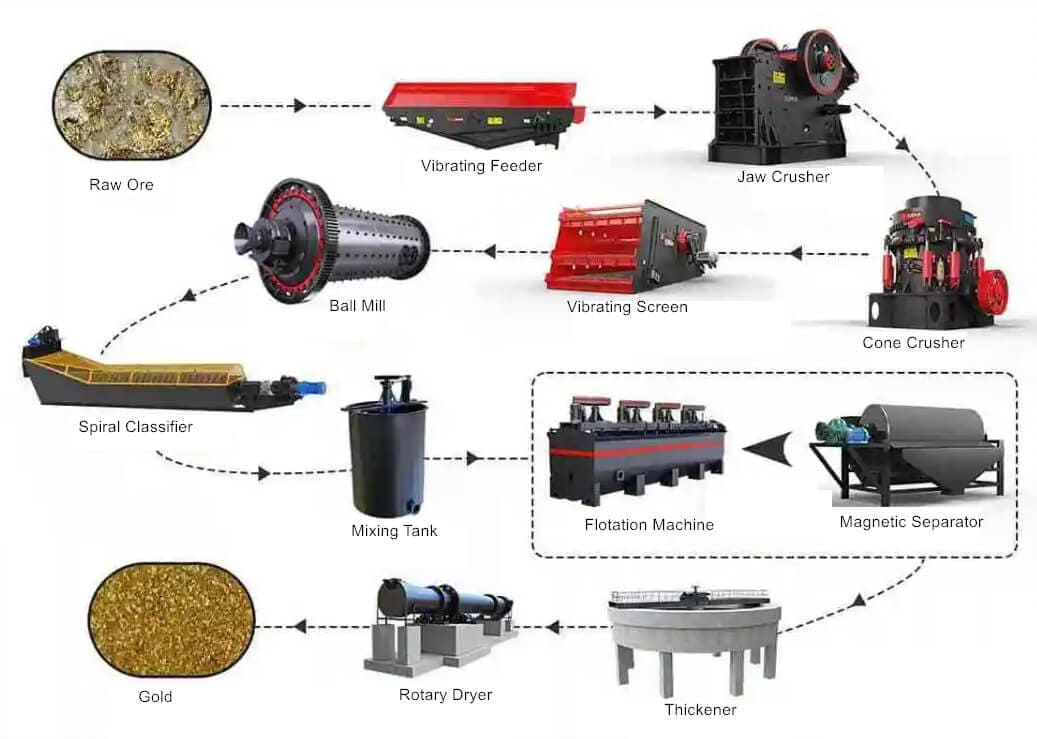
Key Differences Between Flotation and Cyanidation
1. Applicable Ore Types
Flotation: Preferred for sulfide-associated gold deposits (>3% sulfur).
Cyanidation: Best for oxidized ores and native gold with clean surfaces.
Primary Ore Types Suitable for Flotation
- Gold-bearing sulfide ores with high floatability (e.g., gold associated with pyrite)
- Gold ores with fine-grained or disseminated gold particles
- Refractory gold ores containing carbon, arsenic, sulfur, etc.
- Polymetallic gold-bearing sulfide ores
Primary Ore Types Suitable for Cyanidation
- Oxidized Gold Ores
Characteristics: Gold exists in a free state; the ore structure is porous, allowing for easy penetration by cyanide solutions.
Representative Process: Heap Leaching—suitable for low-grade ores with grades below 0.6–1.0 g/t, achieving recovery rates of 65–80%. - Gold-bearing Sulfide Ores (After Pre-treatment)
Characteristics: In their raw state, gold particles are often encapsulated within sulfides such as pyrite or arsenopyrite, resulting in poor recovery via direct cyanidation.
Requirement: Pre-treatment methods—such as roasting, bio-oxidation, or pressure oxidation—are required to liberate the gold particles before proceeding with cyanide leaching.
Representative Process: Agitated Cyanidation (CIP/CIL)—achieving recovery rates exceeding 90%. - Whole-Ore Slurries (High Clay Content/Difficult to Filter)
Characteristics: Traditional filtration methods struggle to achieve solid-liquid separation with these ores.
Suitable Approach: Filtration-free Carbon-in-Pulp (CIP) or Carbon-in-Leach (CIL) processes, which directly adsorb gold from the ore slurry. - Flotation Gold Concentrates
Characteristics: Gold concentrates enriched through flotation are subsequently subjected to cyanide treatment. This approach significantly enhances leaching efficiency and recovery rates, serving as the core component of the combined "Flotation-Cyanidation" process.
2. Recovery Mechanism
Flotation: Physical enrichment (gold-bearing particles).
Cyanidation: Chemical dissolution (gold ions in solution).
Flotation achieves concentration by regulating the wettability of mineral surfaces to float gold or its associated sulfide minerals selectively:
- Hydrophobicity-driven: The surface of native gold is hydrophobic, or it is adsorbed onto the surface of gold particles or carrier minerals such as pyrite via collectors (e.g., xanthate), enhancing their hydrophobicity.
- Bubble Carriage: In an aerated flotation cell, hydrophobic minerals attach to bubbles and rise to the surface of the pulp, forming a foam layer that is skimmed off to producegold concentrate.
- Selective Separation: By adjusting reagents (inhibitors, activators, pH adjusters), the flotation of gangue is suppressed, enabling efficient separation of gold from hydrophilic minerals such as quartz.
Cyanidation is a process that utilizes the complexation reaction between cyanide and gold to dissolve solid gold into soluble complexes, which are then recovered from the solution:
- Chemical Dissolution: Under alkaline (pH 10–11) and oxygen-rich conditions, gold reacts with sodium cyanide to form stable, soluble gold-cyanide complexes: 4Au + 8NaCN + O₂ + 2H₂O → 4NaAu(CN)₂ + 4NaOH
- Adsorption or Displacement: The gold-bearing solution is processed via activated carbon adsorption (CIP/CIL) or zinc powder displacement to recover the gold from the solution in the form of gold-loaded carbon or gold precipitate.
- Refining and Purification: The gold-loaded carbon undergoes desorption and electrolysis to yield gold precipitate, which is then smelted into high-purity gold ingots.
3. Gold Recovery Rates
| Process | Typical Recovery (%) | Note |
| Flotation | 70–85 | Requires further cyanidation |
| Cyanidation | 90–96 | Industry standard benchmark |
4. Environmental & Safety Aspects
Flotation: Lower toxicity reagents, but large volumes of tailings.
Cyanidation: Highly regulated due to cyanide toxicity; requires detox systems.
Beyond technical performance, capital and operating costs significantly influence method selection.
Investment & Operating Cost Comparison
Capital Expenditure (CAPEX)
- Flotation Plant (1,000 tpd): $8–12 million
- Cyanidation Plant (1,000 tpd): $12–18 million (includes cyanide detoxification)
Operating Cost (OPEX) per Ton Ore
| Cost Factor | Flotation ($/t) | Cyanidation ($/t) |
| Reagents | 3–6 | 5–10 |
| Energy | Moderate | High (leach agitation) |
| Tailings Handling | Low | High (cyanide destruction) |
| Labor | Higher | Moderate |
How to Choose: Flotation or Cyanidation?
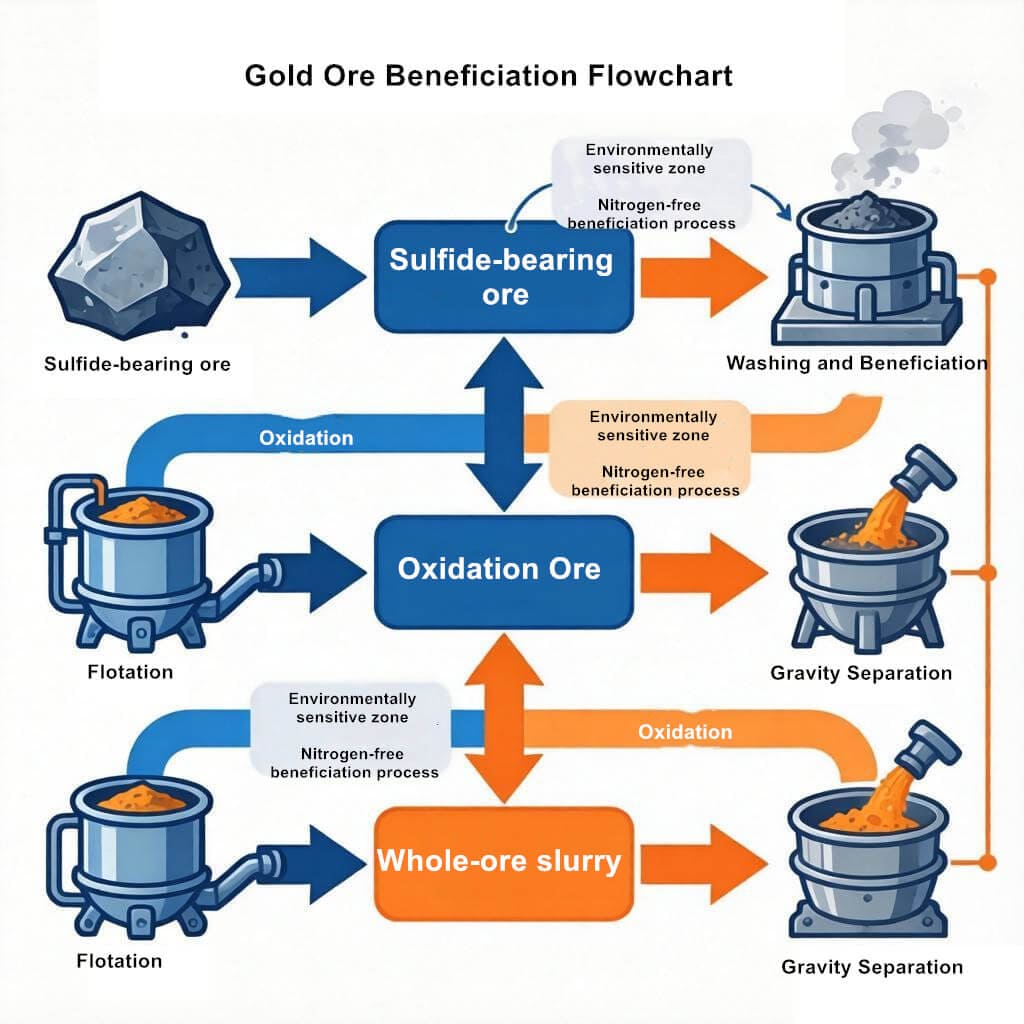
1. When to Prefer Flotation
- Sulfide-dominant ores with economic base metals (e.g., Cu, Pb).
- Projects in eco-sensitive regions with strict cyanide regulations.
- Medium-scale mines aiming for lower initial investment.
2. When Cyanidation Excels
- Oxidized or free-milling gold ores.
- Operations prioritizing maximum gold recovery (>90%).
- Large-scale facilities benefit from economies of scale.
3. Hybrid Approach (Best of Both Worlds)
It is difficult for a single process to balance efficiency and cost; the “flotation-cyanidation” combination has become the standard for achieving high recovery rates:
- Flotation concentration: Removes more than 70% of the waste gangue from the ore to produce high-grade gold concentrate.
- Cyanidation purification: The concentrate undergoes agitation and cyanidation, significantly reducing cyanide consumption (by 20%–30%) and lowering environmental risks.
- Tailings reprocessing: Flotation tailings can be subjected to heap leaching or gravity separation to further recover “residual gold.”
Practice has shown that the total recovery rate of the combined process can exceed 92%, far surpassing that of single-method approaches.
Emerging Alternatives & Conclusion
Future Outlook
Environmentally friendly lixiviants (e.g., thiosulfate, glycine) are gaining traction as cyanide substitutes, especially for ESG-focused projects.
Final Recommendations
- Test ore variability via metallurgical studies before selecting a process.
- For complex ores, evaluate sequential flotation-cyanidation.
- Factor in local regulations, especially for cyanide transport and storage.
By aligning ore characteristics with process strengths, miners can optimize both profitability and sustainability in gold extraction.
Pro Tip: Pilot testing is indispensable—bench-scale recoveries often differ significantly from operational results. Always validate with targeted testwork!